
Steve Jobs was not an engineer, did not hold an MBA, and never finished a college degree. What he had was an unusually precise understanding of why people buy things, what they actually respond to, and how to make a product feel like it belongs to a different category than everything else on the market.
The result was Apple: a company that started in a garage, nearly collapsed in the mid-1990s, and then became the first publicly traded company in history to reach a market capitalization of one trillion dollars. That trajectory is not accidental, and it was not purely a product story. It was a marketing story.
In short, his entire approach comes down to these ten core principles:
- Build a great product first
- Sell a feeling, not just a thing
- Know exactly what you stand for
- Nail the message before the presentation
- Tell a story, don't just list features
- Make every launch an event
- Use mystery to build hype
- Show people what they want instead of asking
- Keep it ruthlessly simple
- Turn buyers into die-hard fans
LESSON 01: Product Is King
The most uncomfortable truth in marketing is that great marketing cannot save a mediocre product. It can generate initial interest, manufacture buzz, and drive trial. But if the product itself does not deliver, no campaign rescues it. Jobs understood this at a level that most companies still resist acknowledging.
When Jobs returned to Apple in 1997, one of his first moves was to cut Apple's product line from 350 items to 10. His reasoning was simple: if the product was not excellent, it should not exist. Every resource should be concentrated on the things worth making.
It's not about pop culture, and it's not about fooling people, and it's not about convincing people that they want something they don't. We figure out what we want. And I think we're pretty good at having the right discipline to think through whether a lot of other people are going to want it, too.
The practical implication is that the sequence matters. Product first, then positioning, then messaging, then distribution. Most organizations invert this. They start with a target market, build something that fits an existing category, and then task marketing with making it seem compelling. Jobs started with a product worth building and then asked how to communicate what made it different.
Guy Kawasaki, who worked directly under Jobs at Apple, put it plainly: most marketers take whatever product they are given and try to make it sound good. Jobs insisted on controlling both the product and the marketing, not just the marketing.
LESSON 02: Sell an Identity, Not a Product
Apple does not sell computers. It never really did. It sells a self-image, a set of values that users adopt by choosing the product. When someone buys an iPhone over an Android device, they are making a statement about who they are, or who they want to be. Jobs understood this mechanism with unusual clarity.
The Think Different campaign, launched in 1997 at arguably the lowest point in Apple's history, did not feature a single Apple product. It featured photographs of Albert Einstein, Martin Luther King Jr., Mahatma Gandhi, Bob Dylan, and others who had changed their respective fields by thinking unconventionally. The message was not about Apple's products. It was about the kind of person who would choose them.
This approach is more difficult to execute than it appears. It requires knowing your audience's aspirations more precisely than their demographics, and building a brand identity that maps onto those aspirations in a way that feels earned rather than manufactured. Jobs had the advantage of genuinely believing in the values he was selling, which made them credible in a way that borrowed brand positioning rarely achieves.
The practical lesson is to ask not what your product does, but what it says about the person who chooses it. The answer to that question is the real product.
LESSON 03: Stand for Something Specific
When Apple launched in 1977, Jobs and early investor Mike Markkula defined three founding principles that Apple would operate by: empathy with customers, focus on doing fewer things exceptionally well, and imputing its values across every touchpoint, from the product itself to its packaging, its stores, and its communications.
That third principle, imputing values consistently, is the one most organizations abandon under pressure. It requires saying no to a great deal that seems reasonable in isolation. A slightly cheaper material in the packaging. A slightly busier interface to accommodate one more feature. A press release written in the house style of the industry rather than in the voice of the brand. Each individual compromise seems trivial. Accumulated, they produce the kind of incoherent brand presence that most companies live with and wonder why their marketing feels weak.
Jobs was obsessive about consistency in a way that made him genuinely difficult to work with and also genuinely effective. He reportedly reviewed and approved every piece of communication that left Apple, not because he distrusted his team, but because he understood that every touchpoint is a brand expression and that inconsistency is noticed even when it cannot be articulated.
The discipline Jobs applied was not just aesthetic. It was strategic. A brand that looks and sounds the same everywhere creates trust through predictability. Trust converts.
LESSON 04: Master the Message, Then the Delivery
Jobs is remembered as one of the most compelling presenters in corporate history. People queued overnight for Apple keynotes the way they queued for concert tickets. But his presentation skill was not a natural gift he was born with. It was the result of extraordinary preparation and a specific philosophy about communication.
He was famously opposed to PowerPoint presentations in internal meetings, not because he disliked slides categorically, but because he believed that relying on slides was a sign that the presenter had not yet mastered their material. If you understand your topic deeply enough, you should be able to talk about it clearly without visual support. Slides, in Jobs' view, should amplify a message that the speaker already owns, not substitute for understanding.
His keynotes were rehearsed for weeks. Every transition was scripted. The pacing was deliberate. He moved from technical specifications to emotional payoff without the audience feeling the shift. The result was presentations that felt spontaneous and genuine precisely because they were so thoroughly prepared.
The lesson is not about presentation style. It is about the relationship between mastery and communication. You cannot present clearly what you do not understand clearly. And the discipline of preparing to present something forces a level of clarity about the message that most organizations never achieve in any other context.
LESSON 05: Lead With Story, Not Specifications
Most technology companies describe their products by listing what they do. Gigabytes, processor speed, resolution, feature count. Jobs described Apple products by explaining what they made possible. When he introduced the original iPod in 2001, he did not say it held 5 gigabytes of storage. He said it held a thousand songs in your pocket.
The specification and the story contain exactly the same information. The specification says nothing that is not also implied by the story. But the specification requires the listener to do the translation work themselves, to imagine what 5 gigabytes of storage means for their daily experience. The story does that work for them.
This is what Jobs meant by storytelling in a marketing context. It is not about narrative for its own sake. It is about presenting facts in terms of their human meaning rather than their technical description. Every feature has a story. Most companies never find it because they stop at the specification.
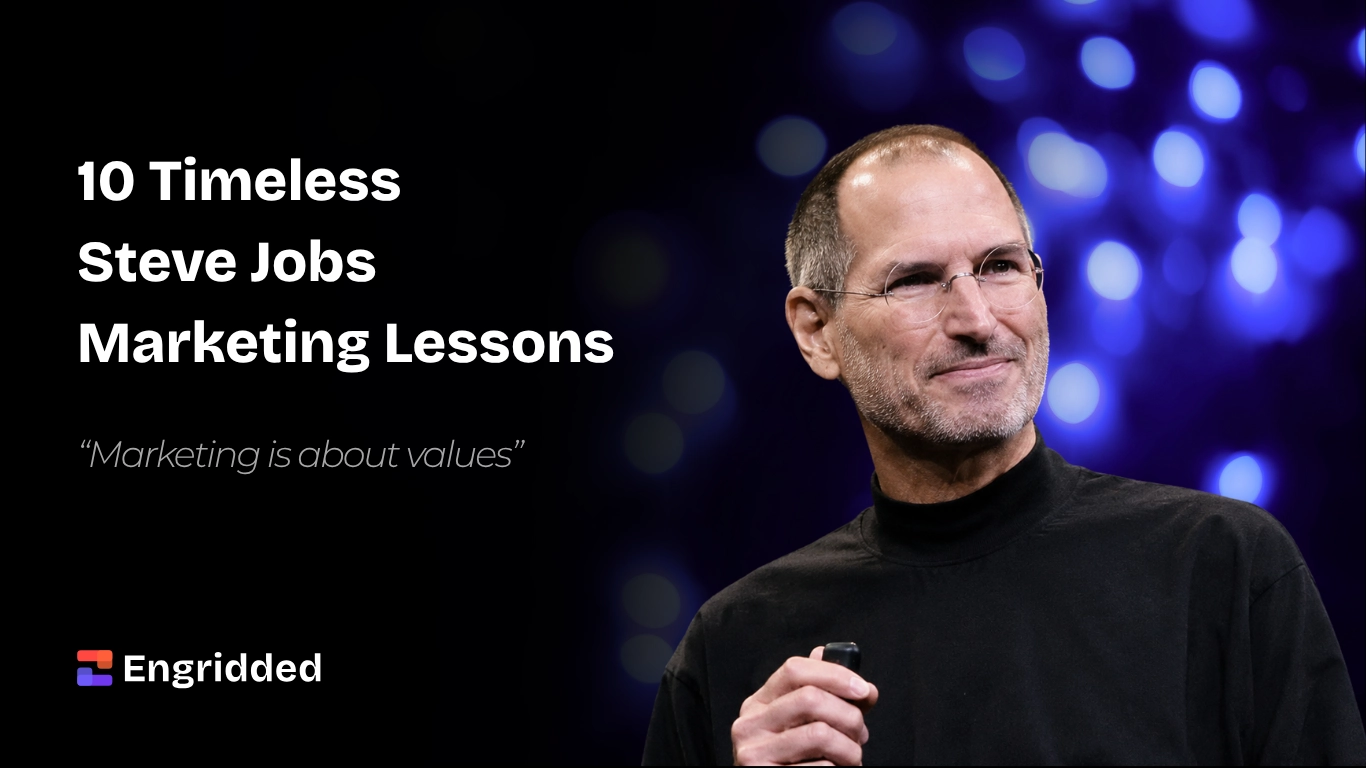
Marketing is about values. It's a complicated and noisy world, and we're not going to get a chance to get people to remember much about us. So we have to be really clear about what we want them to know about us.
The question to ask about any product or service is not what it does, but what it changes for the person who uses it. The answer to that question is the story.
LESSON 06: Create Experiences, Not Just Campaigns
The 1984 Macintosh commercial is one of the most studied pieces of advertising ever produced. It aired once during the Super Bowl, was directed by Ridley Scott, cost approximately 1.7 million dollars to produce and broadcast, and generated enough media coverage to make the Macintosh itself news before it had launched.
Jobs called this approach event marketing: the idea that a campaign itself could be so unusual, so culturally significant, that it would be covered as an event in its own right rather than recognized as advertising. The 1984 spot achieved this. So did the Think Different campaign. So did every major Apple product launch, where the preparation and secrecy around the event made the announcement itself a story that the press covered independently of any paid media.
This approach requires treating every major marketing moment as an experience to be designed rather than a message to be delivered. It asks what it would feel like to be present at this announcement, to encounter this campaign, to open this product. It takes more time, more care, and more creative courage than conventional campaign development. The return is coverage, word of mouth, and cultural impact that paid media alone cannot purchase.
LESSON 07: Keep Secrets and Build Myth
Apple's pre-launch strategy was a deliberate and sophisticated information management exercise. Months before a major product announcement, carefully controlled leaks would begin. A hint here, a rumor there, then contradictory information that kept the speculation alive without revealing anything definitive.
By the time Jobs walked on stage, the product had already been the subject of hundreds of articles, forum discussions, and community debates. The audience arrived not as passive observers but as people who had been engaged in the story for months and were finally going to see how it resolved.
Most marketing operates in the opposite direction: releasing as much information as possible as early as possible in order to generate coverage. Jobs recognized that scarcity of information creates demand for information, and that demand for information converts into demand for the product. The less you tell people, the more they want to know.
Jobs was also famous for his 'one more thing' moment, the practice of ending a presentation that the audience believed was finished, and then revealing one more announcement that reframed everything they had just seen. It was theatrical, deliberate, and extraordinarily effective as a memory device.
LESSON 08: Ignore Focus Groups
Jobs was famously dismissive of market research and focus groups as a tool for product development. His reasoning was not that customer feedback is unimportant, but that customers can only respond to things they have already experienced. They cannot imagine what does not yet exist.
You can't just ask customers what they want and then try to give that to them. By the time you get it built, they'll want something new.
Jobs often cited Henry Ford's aphorism that if he had asked his customers what they wanted, they would have asked for a faster horse. The insight is that incremental improvement can be identified through research. Genuine innovation cannot, because it requires envisioning something that the audience has no reference point for.
This does not mean ignoring customers. It means separating the question of what people want from the question of what they would choose if shown something they had never imagined. Jobs watched people use products intensely and drew conclusions about their frustrations and desires that the people themselves could not have articulated. He then designed solutions to problems that customers had not yet identified as problems.
The practical lesson is to distinguish between research that reveals existing preferences and insight that reveals underlying needs. The first produces incremental products. The second produces category-defining ones.
LESSON 09: Simplicity Is a Strategic Decision
Apple products are not simple because simplicity is easy. They are simple because enormous effort was invested in eliminating everything that was not essential. Jobs believed that designing something simple required understanding it more deeply than designing something complex, because complexity is the natural result of adding things, while simplicity requires the discipline and insight to remove them.
This principle applied across everything Apple produced. The original iPhone had one button on the front face. The MacBook Air was introduced by Jobs sliding it out of a manila envelope to demonstrate how thin it was. Apple's advertising routinely contained fewer than twenty words. The Apple Store was designed with the express intention of removing every element that was not necessary for the customer experience.
The key insight is that simplicity is not a style choice. It is a strategic position. A product that does fewer things better than its competitors in the things that matter most will consistently outperform a product that does more things adequately. Simplicity requires knowing what matters most and having the discipline to protect it against the constant organizational pressure to add, expand, and complicate.
- Remove features that do not serve the core use case, even when they seem harmless
- Reduce visual and communication complexity to the minimum required to convey the message
- Resist the pressure to address every customer segment in every piece of communication
- Design for the experience of the person using the product, not for the convenience of the person building it
LESSON 10: Turn Customers Into Evangelists
The most valuable marketing Apple ever generated was produced by its customers, not its agency. iPhone users did not simply prefer their devices. They advocated for them in conversations, debates, and public forums with a conviction that no paid campaign could replicate, because it was genuine.
Jobs created this dynamic by doing something that most brands approach as a secondary objective: he made customers feel that choosing Apple was a statement about their values, not just a purchase decision. Apple users were not people who had bought a phone. They were people who had aligned themselves with a set of ideas about creativity, individuality, and quality. That alignment created the kind of loyalty that expresses itself as advocacy.
The mechanism behind this is the identity principle from Lesson 2. When a product becomes part of how someone defines themselves, they defend it the way they defend any part of their identity. They share it, recommend it, and argue for it not because they were incentivized to do so, but because doing so is consistent with how they see themselves.
Building this kind of relationship with customers requires a brand that stands for something specific enough to be worth standing for. A brand with no clear identity, no distinct values, and no genuine point of view cannot produce evangelists because there is nothing for customers to identify with. They can only produce users.
Jobs understood that the difference between a customer and an evangelist is not satisfaction. Satisfied customers stay. Evangelists recruit. The difference is whether the product has given them something to believe in.
What These Lessons Have in Common
Reading through these ten lessons, a single thread connects all of them. Jobs operated from a clear and stable set of convictions about what made things good, and he refused to compromise them in response to short-term commercial pressure, conventional wisdom, or the opinions of committees.
He believed that products should be exceptional before they are marketed. That customers respond to identity and story more than to specification. That simplicity is harder and more valuable than complexity. That secrecy creates desire. That customers cannot tell you what they need next because they have never seen it yet.
None of these ideas are complicated. Most of them are already understood at some level by most marketers and business builders. What made Jobs unusual was not that he knew things others did not. It was that he applied these principles with a consistency and a refusal to compromise that most organizations find practically impossible to sustain.
The discipline, more than any individual insight, was what built Apple. And discipline, unlike talent or resources, is available to any organization willing to practice it.