
The honest answer is that there is no single best development approach. Choose Vibe Coding if you want a unique product idea or build a quick prototype. Choose No-Code if non-technical staff need to safely do updates on pages. Choose Low-Code if you have technical staff who need a secure, scalable framework for complex business apps. Each carries real strengths, real limitations, and highly specific contexts where one financially outperforms the others.
At Engridded, we use all three methods, and sometimes all three on the exact same project. The approach we choose depends entirely on what your website needs to do, how fast it needs to launch, how much custom functionality is required, and what your internal team needs to manage after handover.
Understanding the difference between these approaches helps you ask better questions when evaluating an agency, planning your operational budget, and structuring your next digital project. Here is what each approach means in practice and how it impacts your bottom line.
Why This Conversation Matters More in 2026
Building a digital presence used to mean one of two things. You either hired an expensive developer to write raw code, or you used a basic hosted builder and accepted its rigid operational limitations. The gap between those two options was massive in terms of upfront pricing, final quality, and website flexibility.
Three major industry developments changed this equation entirely. Visual no-code platforms matured to the point where their output quality rivals custom development for most standard business needs. Low-code tools gave professional agencies a way to move faster without sacrificing backend control. Finally, artificial intelligence fundamentally changed the actual cost and speed of writing code.
In February 2025, Andrej Karpathy, co-founder of OpenAI, coined the term vibe coding to describe a new way of working with AI: describing what you want in plain language and letting AI generate the code, without reading or understanding what it produces.
The business implications have been massive. Recent industry data shows that 25 percent of new tech startups now operate with codebases that are 95 percent AI-generated, and over 30 percent of new code at major tech companies comes directly from AI assistance.
These are not marginal technical updates. They represent a fundamental shift in how digital infrastructures get built and priced. Understanding these three approaches is critical to avoiding bloated agency retainers, preventing massive security risks, and ensuring your next project actually delivers a measurable return on investment.
The Quick Comparison and Pricing Guide
Before diving into the operational details of each approach, here is how they compare across the dimensions that impact your profit margins the most.
The price ranges above reflect typical market rates for professional agency or freelancer work using each approach. They are not fixed, and the right budget for your website depends on the scope, the complexity, and the quality of the team you work with.
Vibe Coding: What It Is and What It Actually Delivers
Vibe coding is what happens when a developer uses AI tools to generate code by describing what they want in plain language, rather than writing it manually. Tools like Cursor, Claude Code, and similar AI-assisted development environments make this possible. The developer describes the feature, the AI generates the code, the developer tests it and describes any changes needed, and the AI revises.
Vibe coding has produced genuinely impressive results. Custom interactive components that would previously have taken days to build can now be generated in hours. Bespoke animations, unique UI patterns, and custom data visualizations all become accessible without starting from scratch in code.
However, looking at this strictly from an operational perspective, vibe coding carries significant weight. It is not a magic solution that anyone can use flawlessly. It requires a user who understands how to properly prompt the AI, validate the output, and troubleshoot when the machine hallucinates a broken line of code.
Google CEO Sundar Pichai revealed in 2025 that over 30 percent of new code at Google now comes from AI. This is not a fringe experiment. AI-assisted development is already mainstream at the highest levels of the industry.
What vibe coding is genuinely good for
- Custom interactive features that fall outside what any visual builder handles natively
- Specific components like bespoke animations, unique UI behaviors, or unusual integrations
- Prototyping and testing ideas quickly before committing to a full build
- Reducing the cost of custom development when used by a developer who reviews the output
What to watch out for
- A website built entirely through vibe coding by someone who does not understand the output is a maintenance liability
- Security vulnerabilities are a real risk, particularly for websites handling payments or user data
- If your agency cannot explain the code they produced, that is a red flag regardless of how it was generated
There's a reason vibe coding is dominating conversations right now: in the hands of a skilled professional who knows what quality looks like, it is an incredibly efficient way to build and iterate. Use it as a strategic accelerator within a broader workflow, not as a license to bypass engineering discipline. Skip that step, and even the slickest demo will collapse the moment real users show up.
No-Code: The Most Practical Choice for Most Business Websites
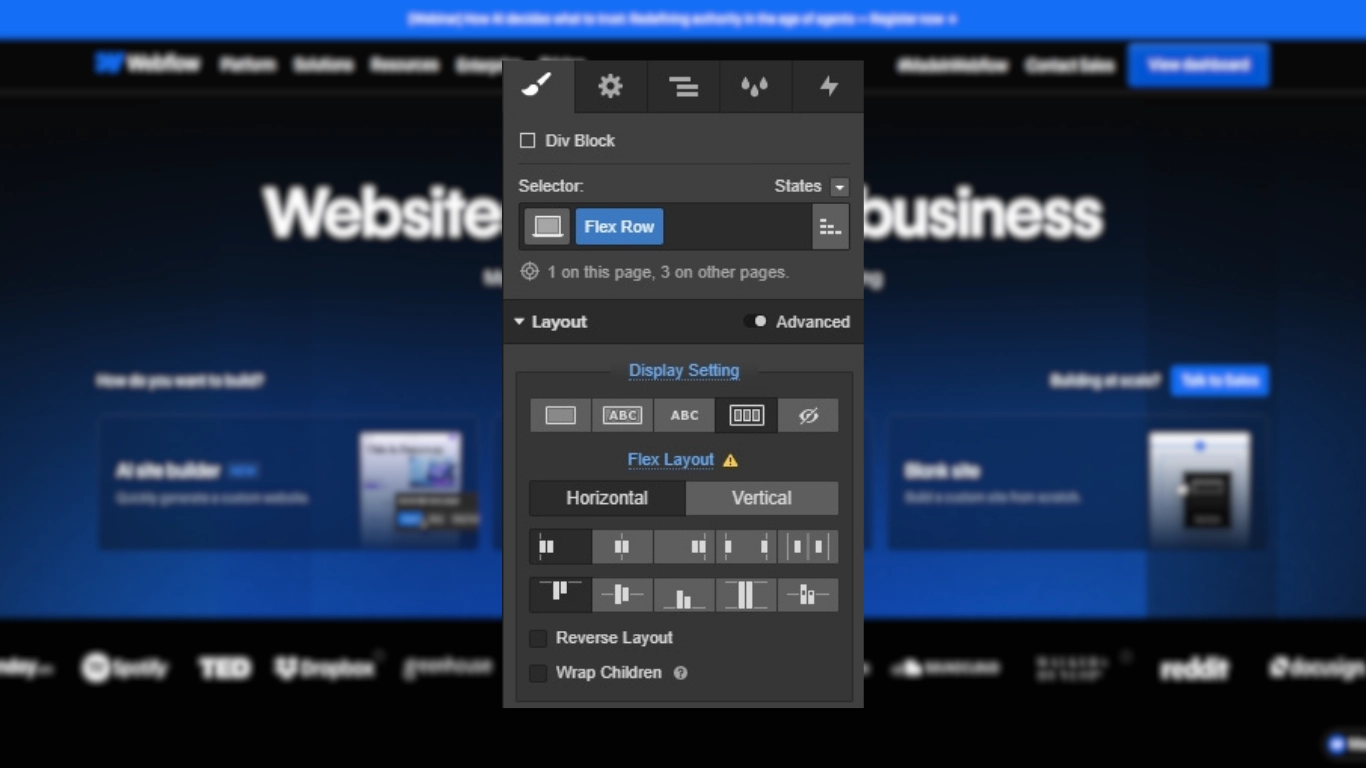
No-code means your website is built using a visual design tool without writing any code. The designer sees the website as it will appear to visitors, makes changes visually, and the platform translates those decisions into clean, performant output automatically.
For most business owners, no-code is the approach that makes the most sense, not because it is the cheapest option, but because it consistently delivers the best combination of quality, speed, cost, and long-term manageability. The perception that no-code means low quality is about five years out of date. Modern no-code platforms built for professional web design produce websites that are visually indistinguishable from custom-coded results and, in many cases, perform better on load speed and technical SEO.
No-code is not a compromise. It is a strategic operational choice. If you need a fast-loading, distinctive website where your administrative team can update content without begging a developer for help, no-code is often the most financially sound choice.
What no-code is genuinely good for
- Professionally designed, fast-loading business websites that your team can manage independently
- Websites that need to rank well in search: no-code platforms produce clean technical output
- Projects that need to launch in weeks rather than months
- Businesses that want low ongoing maintenance cost and no dependency on a developer for routine updates
- Most service businesses, professional practices, consultants, coaches, and local businesses
Where no-code reaches its limits
- Highly specific legacy database structures that require custom middleware to communicate.
- Application logic that requires heavy server-side processing, such as building a completely original software application or a proprietary financial trading engine.
Most service businesses, clinics, and consulting firms will never encounter these technical limits. The ones that do typically need low-code capabilities for specific elements rather than abandoning the stable no-code foundation.
Low-Code: The Bridge Between Visual Speed and Custom Power

Low-code means your website is built on a visual foundation with custom code added for functionality that the visual builder cannot handle natively. A low-code environment gives an agency the visual interface and pre-built components of a no-code platform while making the underlying code fully accessible to developers.
For your operations, this means a professional designer can build and control the visual user experience rapidly, while a specialized developer extends the functionality with custom code only where absolutely necessary. The two can work in the exact same environment without constantly switching between separate tools.
Low-code also perfectly integrates safe AI assistance. A human developer uses AI to generate complex functions, but the human strictly reviews, secures, and controls the final output. This neutralizes the security risks associated with pure vibe coding.
When you actually need low-code
- Unique user portals: You need a secure, custom-built dashboard where your clients can log in, view specific data, and interact with your backend services in ways standard templates cannot support.
- Auditable security: Your industry compliance regulations require your team to have complete visibility and control over how data is processed, stored, and routed through custom codebases.
The pricing reality of low-code
Because this approach requires the involvement of specialized engineers, the pricing structure changes dramatically. Setup costs generally start at $8,000 and can easily exceed $40,000 depending on the depth of the custom coding required. Furthermore, because custom code is introduced, you will likely need to retain a developer for $500 to $1,000 or more each month just to ensure the custom bridges do not break during routine software updates.
For projects that need to launch fast and do not have genuinely unusual integration requirements, paying for low-code complexity rarely translates into proportionally higher revenue.
How We Deploy All Three at Engridded
The practical reality of digital growth is that the right approach depends entirely on your specific bottlenecks. We do not force a single method onto every client, and you should be highly skeptical of any agency that does.
For most ambitious businesses, our foundation is no-code. The output quality is exceptional, the performance metrics rank highly on search engines, and the maintenance overhead is incredibly low. For the vast majority of what businesses actually need to capture leads and process payments, no-code delivers results that match custom development at a fraction of the time and cost.
When a project requires something the visual framework cannot handle natively, we introduce low-code capabilities for that specific component. A custom API connection to your dispatch software. A database-driven section that pulls live inventory from a legacy system. These are not reasons to rebuild the entire digital environment from scratch in raw code. They are simply reasons to extend a powerful no-code foundation with targeted low-code engineering.
Vibe coding enters our workflow strictly as an internal accelerator. We use AI to generate first drafts of custom components or to rapidly explore interactive behaviors before we commit to building them fully. Because our professional developers review and refine every line of AI-generated output, our clients get the speed benefits of vibe coding with zero security vulnerabilities.
This hybrid approach produces digital infrastructures that launch quickly, operate flawlessly, and can be maintained effortlessly over time.
The True Cost of Maintenance: What Happens After Launch
Most conversations about development focus entirely on how the project gets built. Your primary concern should be what happens after it goes live.
A website is never truly finished. Services get added, seasonal pricing changes, and automated workflows need adjusting. The approach used to build your digital presence dictates exactly how expensive and painful it will be to maintain over the next five years.
Choosing a website building approach without thinking about ongoing maintenance is like choosing a car based entirely on how fast it accelerates. The maintenance cost, ease of repair, and running costs matter just as much over the life of the vehicle.
This is exactly why the building approach cannot be separated from the operational system behind it. The most beautifully coded website in the world still loses money if it is not directly connected to a central system that captures every lead and automates daily follow-ups. The building approach determines the quality of the front door. The system behind it determines whether that front door actually works.
Which Approach Is Right for Your Business?
The ultimate question is not which approach is technically superior in the abstract, but which path removes the most operational friction from your daily workflow.
If you need a fast, professional, high-converting digital presence that your internal team can manage independently, no-code is undeniably the most efficient path. It shifts your technology budget from a massive, risky capital expense into a predictable, growth-focused operational expense.
If you have highly specific backend workflows, legacy software tools that refuse to integrate easily, or proprietary algorithms that need to run seamlessly, low-code capabilities become necessary. The key is applying them only where they add genuine, measurable revenue rather than adding technical debt for its own sake.
If extreme speed matters the most, vibe coding is fascinating. With the right people who know what they're doing, however, it can be a legitimate business strategy.
The smartest organizations don't treat these approaches as competing ideologies; they treat them as a spectrum, deploying each where it actually moves the business forward. At the end of the day, the only metric that matters is whether your technology makes you faster, more profitable, and less dependent on external gatekeepers.
FAQ