
Everyone is talking about AI agents. But most explanations skip the part that matters most: there are different types, and choosing the wrong one means wasted budget and frustrated customers.
Imagine hiring a team member who never sleeps, remembers every conversation, can browse the web, send emails, update your CRM, and make decisions based on the goal you gave them, all without you clicking a single button. That's the promise of AI agents. And in 2026, it's no longer just a promise.
What exactly is an AI agent?
An AI agent is a software system that uses artificial intelligence to pursue goals and complete multi-step tasks on your behalf. Unlike a regular chatbot that just answers questions, an agent can reason through a problem, make a plan, take action, check the results, and adjust, all on its own.
Think of it like the difference between asking Google Maps: "how do I get to Rome?" and actually having a personal travel assistant who books the flights, arranges the hotel, sends your team a calendar invite, and follows up when your visa is ready.
Simple definition: A chatbot responds to what you say. An AI agent acts toward a goal, even across multiple steps, tools, and time periods.The key difference is autonomy. Agents can make decisions, use tools, and complete tasks without you guiding every step.
How do AI agents actually work?
Every AI agent is built around four core components. Understanding these will help you make smarter decisions when evaluating tools for your business or clients.

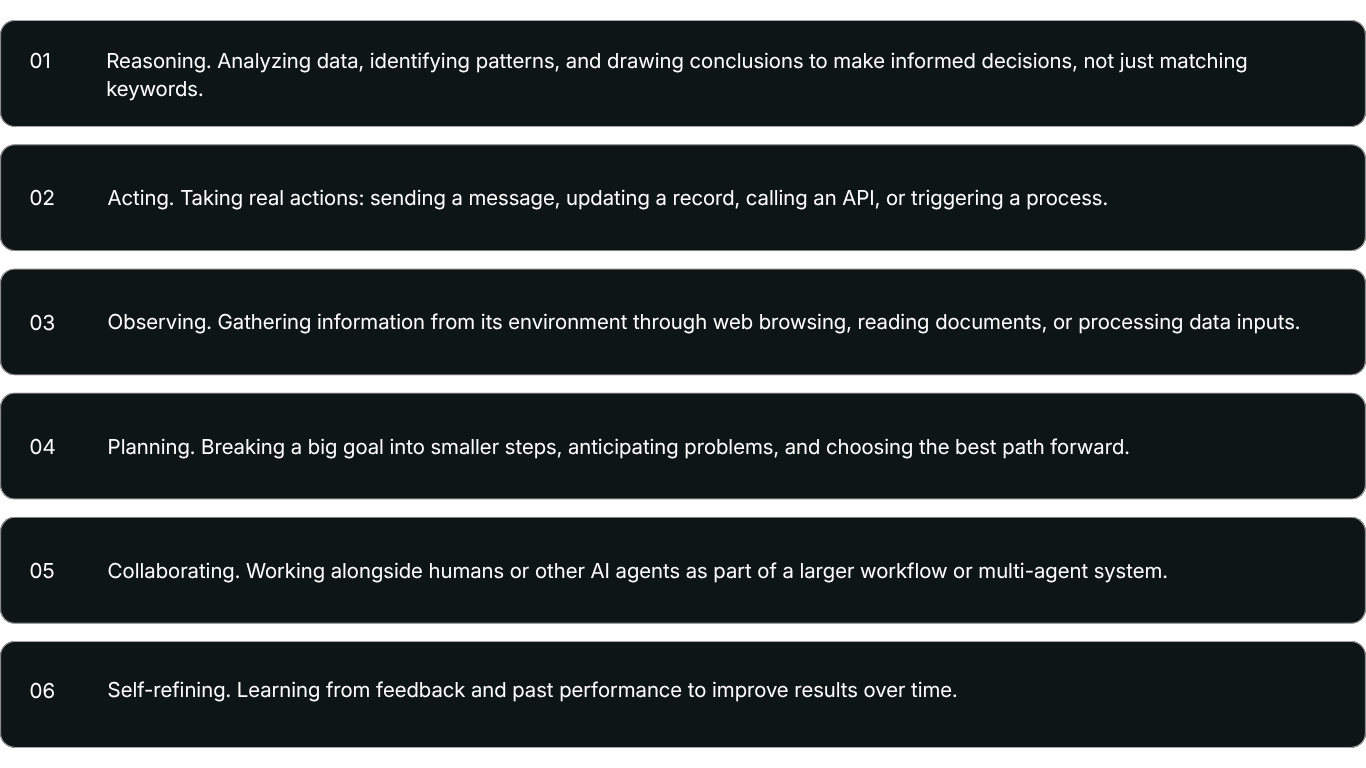
6 core capabilities every AI agent has
Modern agents aren't just "if this, then that" systems. They come with a surprisingly human set of capabilities:
3 Types of AI agents
Not all AI agents are the same, and this is where most agencies get vague. At Engridded, we build three distinct types, each designed to solve a specific problem in your business operations.
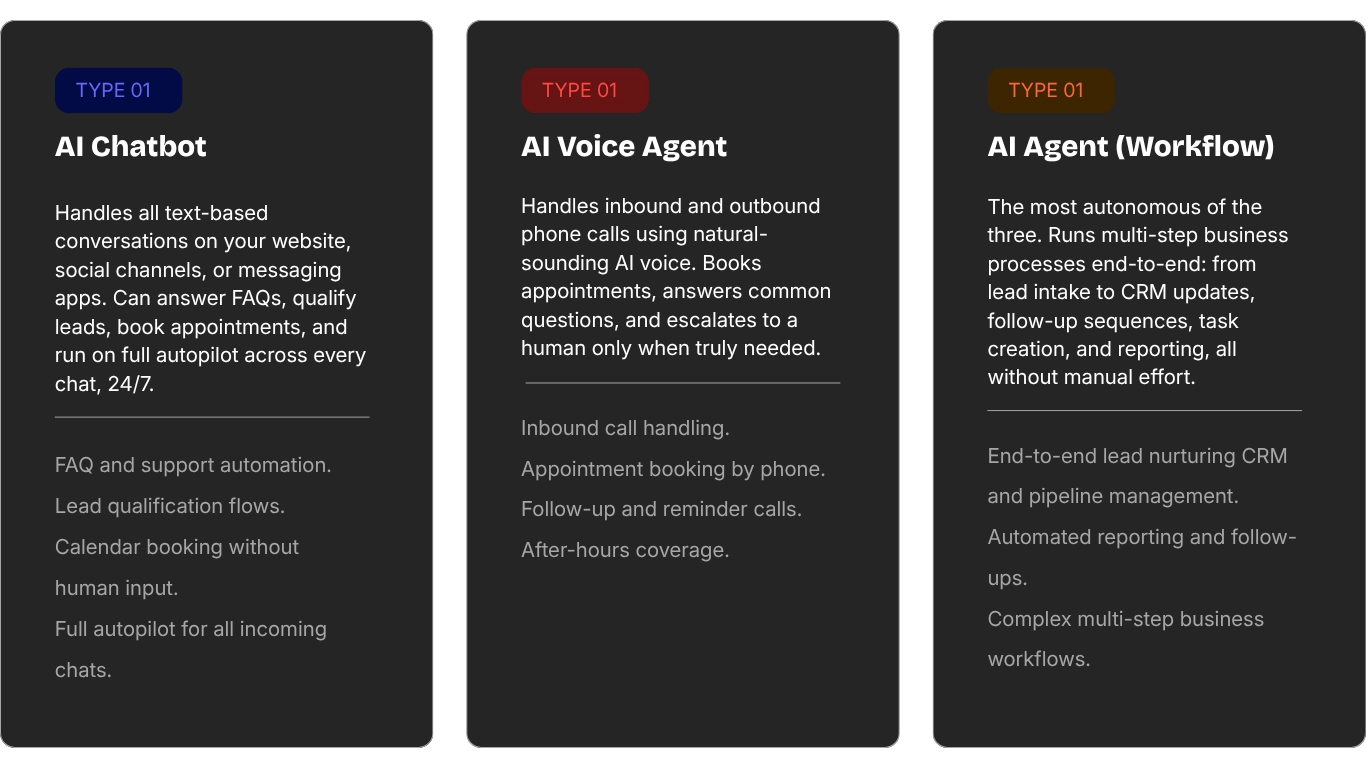
How to think about it: The chatbot handles the conversation. The voice agent handles the call. The workflow agent handles everything that happens behind the scenes after that first contact is made.
How AI agents work under the hood
You don't need to understand the engineering to use AI agents well. But knowing the basics helps you ask better questions and avoid being sold something that doesn't fit your needs.
Every AI agent is built around four components. First, a persona: the defined role, tone, and instructions that tell the agent who it is and how to behave. Second, memory: the ability to remember past interactions, customer data, and context so responses stay relevant. Third, tools: the integrations and functions the agent can actually use, like searching a knowledge base, booking a calendar slot, or updating a record. Fourth, the model: the large language model (LLM) that does the actual reasoning and generates responses.
Put those four together and you get a system that can hold a real conversation, make decisions, take action, and learn over time. That's the engine behind every agent we build.
Real use cases for businesses right now
Here's what AI agents are actually doing for businesses today, not in theory, in practice:

Limitations you need to know
We believe in being honest about this because it helps you make smarter decisions as a business owner.

How to know what you need
The easiest way to identify which agent type fits your business is to ask one simple question: where are you losing the most time or leads right now?
If the answer is "we miss chats and DMs constantly," you need an AI chatbot. If it's "we miss calls or can't handle volume," you need a voice agent. If it's "our follow-up process is inconsistent and manual," you need a workflow agent. And if it's all three, we can build a system where all three work together.
At Engridded, we don't just hand you a tool and wish you luck. We map your workflow, identify the highest-leverage automation points, build the agent system, and make sure it's actually doing what it's supposed to do before we call it done.
Ready to put AI agents to work in your business?
Whether you need a chatbot that never sleeps, a voice agent that handles your calls, or a full workflow system that runs your backend, we build it end to end. Let's talk about what makes sense for you.
FAQ